In June 2023, the IStReS database has reached and surpassed 2500 references on Iberian Studies, including books, book chapters and journal articles. Among the latest publications added to the database are Enric Bou and Silvia Lunardi’s Iberismo(s), Esther Gimeno Ugalde’s article “Conceptualizaciones del espacio ibérico: posibles aportaciones para los Estudios de Traducción”, or a selection of Conceição Meireles Pereira and David Wacks’ publications.
The work of our latest collaborator in the project, Miriam de Sousa (Centro de Estudos Comparatistas, FLUL) has been central in helping the database grow beyond this symbolic number of 2500 references.
The ISTRES – Iberian Studies Reference Site project (http://istres.letras.ulisboa.pt/) offers several tools for researchers in the field of Iberian Studies. One of these tools, central to the project, is a database of scholarly publications after the year 2000 (inclusive), dealing with historic and cultural relations between at least two Iberian “cultural areas” (Spain and Portugal, Portugal and Galicia, etc.).
You can keep up to date with IStReS news by suscribing through the box at the bottom of the page, of by following us on Twitter.
Enric Bou and Silvia Lunardi (eds.). Venice: Ca’ Foscari, 2023
This volume is the result of the debates held at Ca’ Foscari University during the Iberismo(s) study day, aimed at discussing the ethical, theoretical and methodological limits of Iberian Studies and demonstrating their applications. Far from a unidirectional reading, the works gathered here explore the multiple aspects of Iberism, or rather Iberisms: different aspects such as the literary, cultural, economic and political ones are taken into account and interpreted on the basis of their plurality – since the diversity of actors, discourses, and contexts makes it impossible to outline a closed narrative.
According to Claudio Guillén, “national literature is […] an institution that is not only insufficient, but also spurious and fraudulent”, hence the commitment to redefine this field of study. Moreover, its analytical perspective is associated with the ‘crisis of Hispanism’ as a ‘uninational’ and monolingual paradigm. Iberian Studies as such do not take root in a simple broadening of the object of research in order to give space – and thus a new location – to the more peripheral realities; it is rather a theoretical and methodological reformulation in constant development, as all the essays in this volume attest.
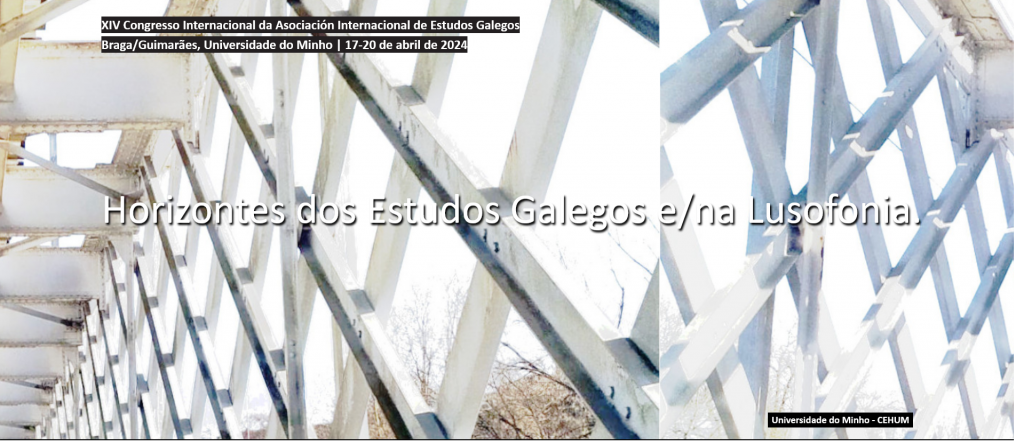
O XIV Congresso da Asociación Internacional de Estudos Galegos (AIEG) terá lugar na Universidade do Minho (Braga/Guimarães, Portugal), de 17 a 20 de abril de 2024.
Sob o título Horizontes dos Estudos Galegos e/na Lusofonia, o XIV Congresso da AIEG pretende ser um espaço para a reflexão da relação entre a Galiza e os estudos galegos com o que se tem denominado de Lusofonia. Como se sabe, já nos inícios da irrupção do galeguismo cultural (e político) no século XIX – e, portanto, em boa medida, também do início do que podemos entender por estudos galegos – Portugal e a sua cultura – o mundo em português em geral – ocuparam uma posição não menor nas elaborações dos galeguistas. Com o passar dos anos, se a chamada questione della lingua, problematizou polemicamente o encontro, o relacionamento, hoje, num novo contexto marcado, entre outros fatores, pela construção europeia, as relações de variado signo aos dois lados do rio Minho ou mesmo do oceano Atlântico e doutras latitudes, experimentam um novo fôlego, muito provavelmente inédito na Época Contemporânea.
Neste quadro, sob uma diversidade de abordagens, este congresso pretende promover o debate sobre as relações culturais e outras entre a Galiza e a Lusofonia que podem partir de questões como: estamos na atualidade perante um novo tempo nas relações de variado tipo entre Galiza-Portugal-Lusofonia?; a chamada Euro-região Galiza-Norte de Portugal é uma entidade com dimensão cultural?; quais são os elementos culturais (língua, história, paisagem, etc.) em que se apoia(va)m as iniciativas de inter-relação?; em que medida os Estudos Galegos devem/podem estabelecer pontes com o espaço poliédrico da Lusofonia?
Línguas do congresso: galego e português (a comissão organizadora poderá aceitar propostas noutras línguas).
Prazo para o envio de propostas: 1 de junho – 1 de outubro de 2023
A Cátedra de Estudos Ibéricos da Universidade de Évora, dirigida por Antonio Sáez Delgado, organiza um novo ciclo de conferências online Polibéricos. Nesta ocasião, o ciclo terá por tema Velhos modernos – Novas visões, e contará com a participação de Xavier Núñez-Sabarís (Universidade do Minho), Laurie-Anna Laget (Sorbonne Université), Mariana Pinto dos Santos (Universidade NOVA de Lisboa), Margarida Casacuberta (Universitat de Girona), Aiora Sampedro (Universidad de Salamanca), Nicolás Fernández-Medina (Boston University) e Giorgio de Marchis (Universitá Roma Tre).
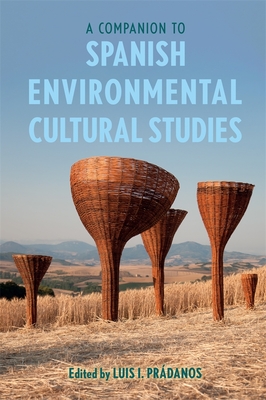
Luis I. Prádanos (ed.) Tamesis Companions, Boydell & Brewer, 2023.
From the scars left by Franco’s dams and mines to the toxic waste dumped in Equatorial Guinea, from the cruelty of the modern pork industry to the ravages of mass tourism in the Balearic Islands, this book delves into the power relations, material practices and social imaginaries underpinning the global economic system to uncover its unaffordable human and non-human costs. Guiding the reader through the rapidly emerging field of Spanish environmental cultural studies, with chapters on such topics as extractivism, animal studies, food studies, ecofeminism, decoloniality, critical race studies, tourism, and waste studies, an international team of US and European scholars show how Spanish writers, artists, and filmmakers have illuminated and contested the growth-oriented and neo-colonialist assumptions of the current Capitalocene era. Focussed on Spain, the volume also provides models for exploring the socioecological implications of cultural manifestations in other parts of the world.
Contributors to the volume are Eugenia Afinoguénova, Samuel Amago, Daniel Ares-López, Kata Beilin, John Beusterien, Miguel Caballero Vázquez, Jorge Catalá, Glen S. Close, Jeffrey K. Coleman, Jamie de Moya-Cotter, Ana Fernández-Cebrián, Ofelia Ferrán, Tatjana Gajic , Pedro García-Caro, Santiago Gorostiza, Germán Labrador Méndez, Maryanne L. Leone, Shanna Lino, Jorge Marí, José Manuel Marrero Henríquez, Maria Antònia Martí Escayol, Christine Martínez, Cristina Martínez Tejero, Micah McKay, Pamela F. Phillips, Mercè Picornell, Luis I. Prádanos, Cécile Stehrenberger, John H. Trevathan, Joaquín Valdivielso, William Viestenz, Maite Zubiaurre
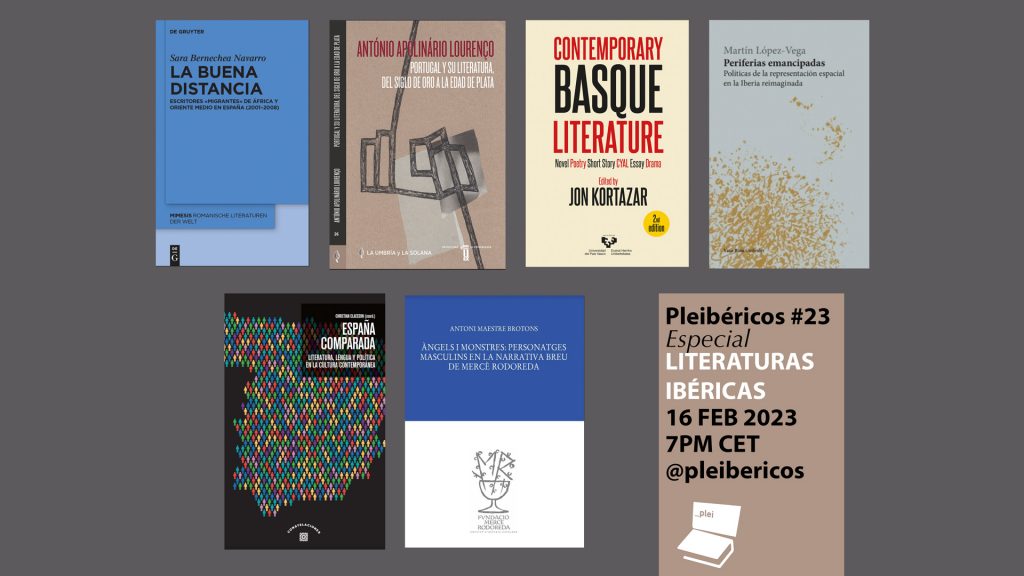
El próximo encuentro de Pleibéricos tendrá lugar el jueves 16 de febrero, a las 19 horas, y estará dedicado a las literaturas ibéricas. El encuentro estará moderado por Katiuscia Darici (Universidad de Turín) y Esther Gimeno Ugalde (Universidad de Viena). Serán presentadas las siguientes novedades editoriales:
Por otra parte, se encuentra ya disponible la última entrevista de podcast (primera en gallego) del canal de Estudios Ibéricos, en colaboración con NewBooks en Español, realizada por Diego Rivadulla, sobre el volume Ainda invisíveis? Narradoras e margens na literatura galega contemporânea, de Lorena López López.